
If you’re in charge of managing a firm, you’re probably always seeking for innovative approaches to improve operations, expand your clientele, and streamline as many procedures as you can.
Sadly, it can occasionally be challenging to figure out how to apply the right program to be effective. For this reason, a case study is a popular choice among business owners and can be quite beneficial.
Whether you’ve experienced brand consistency issues or another issue, the correct case study may explain why your issue arises as well as suggest solutions.
For more technical SEO insights, explore our Core Web Vitals checklist and SEO fundamentals guide.
Many organizations aren’t even aware that a case study is a useful tool, and there are marketing professionals like Mailchimp that can give you step-by-step guidance on carrying out a strategy with a case study. Many businesses learn that in order to grow their business, they not only need to start a blog, but they also need to come up with precise, pertinent blog names.
Case studies can help you understand more about your company and do additional research with strong qualitative data analysis.
Optimizing your blog entries may be useful if your business already has one. A case study can do wonders for you in helping you resolve any issues that are keeping you from attaining all of your professional goals.
What is a Case Study?
A case study is a thorough analysis of the findings from theory testing or looking at new business themes in the context of actual business operations. While doing health services research with a major focus on routinely gathered healthcare data, case studies are frequently employed in the healthcare sector.

For enterprises, a case study’s goal is to assist owners of small firms or company executives in identifying problems and conducting additional research into potential barriers to success through information gathering, client or customer interviews, and in-depth data analysis.
It is simpler to make the necessary adjustments to encourage success through impacted data collecting when a company can clearly identify the problems preventing it from accomplishing all of its objectives.
What are the Benefits of Writing a Business Case Study?
Even though it may seem like laborious work to write a case study, there are several advantages to doing one through a thorough qualitative research process.
An in-depth insight into your sector through a specific conceptual framework may be gained from a case study, and it can also aid in the discovery of hidden issues that are blocking you from advancing into the commercial world.
Second, creating a strong case study can significantly increase your chances of solving your issue and growing your company.
Limitations:
There are some restrictions, but case studies can be an excellent tool for any organization of any size to utilize to understand their clients, products, consumers, or services in depth.

As you are usually performing a single case study rather than several, case studies have the drawback that there is nothing to compare them to unless there are other recently published examples.
Another drawback is the common absence of scientific support in case studies.
Types of Case Studies
There are various types of case studies to pick from, and each type will produce a different set of outcomes. Certain case study types even overlap, which is occasionally preferable because they offer even more useful information.
Here are descriptions of the several case study kinds, each having a distinct theoretical foundation, so you can choose the one that will work best to further your objectives.
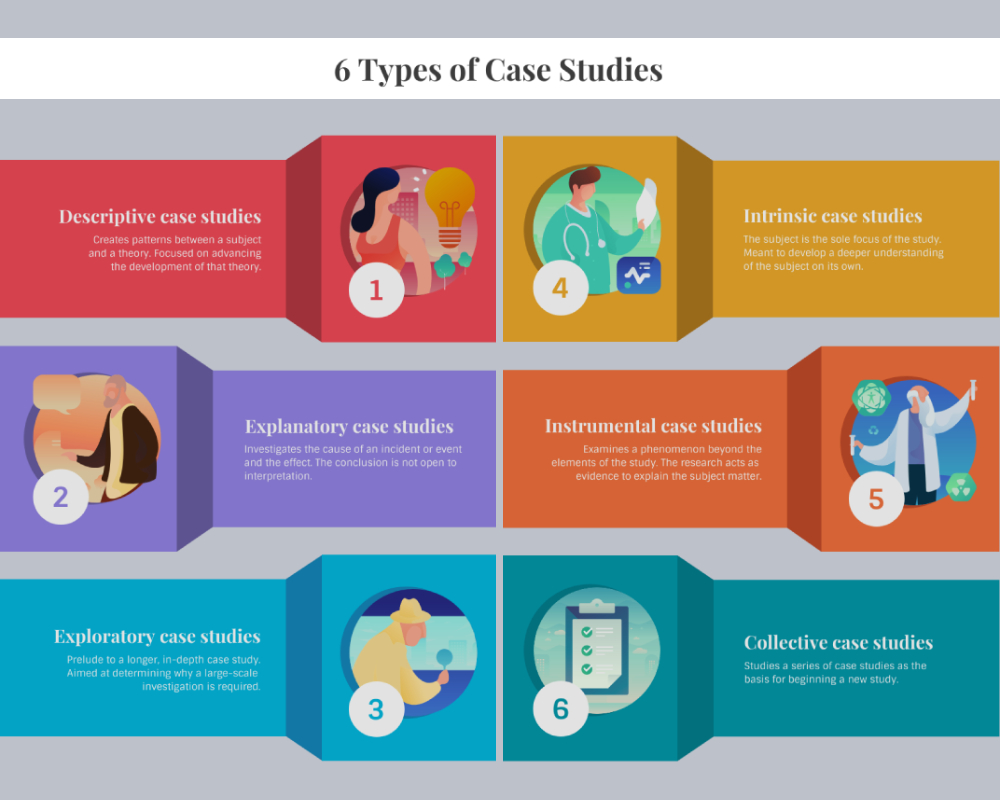
1. Explanatory
Explaining case studies are rather simple to understand and doesn’t require much interpretation. Explanatory case studies are most effective when there are few variables at play since they may readily provide answers to “how” and “why” questions through the construction of theories.
2. Exploratory
An exploratory case study does precisely what its name implies: it uses qualitative research to delve deeply into the subject at hand in a context that is naturally occurring in real life.
Exploratory case studies provide a plethora of advantages, the most important of which is that they provide a great lot of freedom. It’s crucial to be adaptable when creating a case study because you can never be sure what challenges will come up while conducting qualitative research.
3. Collective
In order to gather useful data for collective case studies, many diverse people must be studied.
Case studies involving the investigation of individuals will involve a wide range of unpredictable circumstances. Despite this, there are several advantages to doing group case studies, one of which is the ability to continuously analyze the data gathered.
4. Intrinsic
This form of research varies from others in that it concentrates on a single occurrence among many potential ones.
These kinds of case studies are popular because they enable people to understand more about the specific situation they want to look into further.
5. Instrumental
Similar to an intrinsic case study, an instrumental case study concentrates on a specific instance, whether it be a person, an organization, or something else entirely.
The fact that instrumental case studies aren’t selected just because a person is interested in learning about a particular incident is one feature that distinguishes them from intrinsic ones.
Case Study Writing Tips
You might be unclear of where to begin or which kind to undertake if you have opted to write case studies for your business.
But, starting a case study that will aid you in identifying methods to enhance your organization doesn’t have to be challenging or perplexing.
The following advice will help you write your case studies:
1. Your Case Study Needs to be Formatted Correctly.
When writing a case study, you should follow a format like this:
i) Administrative summary
The executive summary is a succinct overview of your report’s contents that provides context from actual events.
Although the executive summary should be included at the start of your case studies, you shouldn’t write it until you’ve finished the entire report because, if you do, this summary might not be entirely correct.
ii) Key problem statement
You will briefly describe the issue that the study is intended to address in this portion of your case study. As you get into the breadth of the report, you will have the chance to go into more detail on the issue you are concentrating on.
iii) Problem exploration
This section of the case study is longer than the other two and contains additional information about the current issue. You must explain the need for and urgency of tackling the identified problem in your problem exploration.
The problem-solving process must also be justified because the advantages must surpass the expenses and efforts.
iv) Proposed resolution
Also, this portion will be longer than the previous two. It must outline the steps you suggest taking to address the issue. You should outline any potential difficulties you may run into in the “suggested solution” section, as well as how you plan to handle them.
You should also identify other alternatives and explain why the one you chose is the best. Charts may improve your report, make it easier to understand, and offer as much evidence as possible to support your point.
v) Overview of monetary consideration
Every case study must include a summary of financial considerations because it will be used to persuade all parties involved that your idea deserves funding. You must be able to persuade them that the expense justifies the time and effort it will demand. You should emphasize the significance of this particular case study and describe the predicted results.
vi) Execution timeline
You describe how long you anticipate it will take to implement your study in the execution times of case studies. Your idea is more likely to be approved the faster it can be put into action. But make sure to give a realistic deadline, including any additional time that could be required because of challenges.
vii) Conclusion
Always end your case study with a conclusion that briefly summarize your entire plan and highlights the advantages of finishing the data collecting and analysis in order to solve your problem.
2. Make it Clear and Comprehensive
So that every part of the report is understood, you want to write your casestudies as clearly as you can. To avoid submitting a paper that is poorly written, double-check your grammar, spelling, punctuation, and other writing elements.
A poorly written case study would increase the likelihood that your report would be ignored and not be taken seriously in addition to failing to demonstrate the significance of what you are attempting to accomplish.
3. Do not Hasten the Procedure.
It takes effort and perseverance to write the ideal case study. Rushing could cause you to overlook details that are essential to your overall research. Stop wasting your time on research that isn’t ready. Spend the time necessary to conduct all the research required to produce the finest case study you can.
Doing research may involve employing qualitative, quantitative, or both methodologies, depending on it. Qualitative research questions concentrate on non-numerical information including people’s feelings, views, experiences, and so forth.
In contrast, quantitative research questions concentrate on gathering numerical or statistical data in order to identify patterns or understand causal relationships.
It’s crucial to get enlightening and helpful criticism. This will aid in your comprehension of the result and any necessary adjustments to be made to subsequent case studies. To guarantee that you obtain a variety of thoughts and viewpoints, think about employing both formal and informal methods to gather input.
4. Be Assured of the Growth of Your Theories.
You should be confident in yourself and the ideas you’re putting forth in your report while composing your case study or carrying out your formal experimental inquiry. Don’t doubt your ability or question yourself if you took the time to compile all the necessary facts for the report. Your report will probably be fantastic if you think it will be.
5. All Qualitative Research is Long
There is no getting around the fact that numerous case studies will be terribly boring. It does not, however, imply that you cannot choose your words carefully in order to maintain the highest level of audience involvement.
For whatever reason, it raises the risk that your case study won’t get financed if your audience loses interest in it right away.
Creating Numerous Case Studies For Your Company
You are not alone if the thought of preparing a case study leaves you feeling entirely unprepared. Creating it for a business is a huge undertaking, but thankfully assistance is accessible as case study examples aren’t always helpful.
You can get help with your case study from Mailchimp, a well-known marketing firm that offers thorough marketing support for all kinds of firms, or you can look through one of their own newly released examples.
To maximize your chances of being as successful as possible, Mailchimp can help you design the best content strategy. The content studio by Mailchimp is a fantastic tool that can be very beneficial to your company.
Frequently Asked Questions
Q: What is this guide about?
This comprehensive guide provides strategies and best practices for achieving success in your marketing efforts. Following these approaches can help improve your results and competitive advantage.
Q: How long does it take to see results?
Results vary depending on consistency and implementation quality. Most strategies require 3-6 months of dedicated effort before significant improvements become visible. Ongoing optimization is essential.
Q: Do I need professional help?
While basic implementation can be done independently, professional guidance often accelerates results and helps avoid common mistakes. Consider experts if you lack internal resources.
Q: What are the most important factors for success?
Key success factors include thorough research, consistent execution, quality over quantity, regular performance monitoring, and adapting to industry changes.
Q: How do I measure success?
Success depends on your goals but typically involves tracking KPIs like traffic, conversions, revenue, and engagement rates. Regular analysis helps identify improvements.
Q: What digital marketing channels should I focus on?
The best channels depend on your audience. Most businesses benefit from SEO, content marketing, social media, and paid advertising. Start where your audience is most active.
The Evolution of Digital Marketing: From Traditional to Modern Approaches
Digital marketing has undergone a remarkable transformation over the past two decades, evolving from simple banner advertisements and email campaigns to sophisticated, data-driven strategies that leverage artificial intelligence and machine learning. Understanding this evolution provides valuable context for developing effective modern marketing strategies that resonate with today’s consumers.
The early days of digital marketing were characterized by interruptive advertising tactics that prioritized visibility over relevance. Companies spent significant budgets on display ads that reached broad audiences but delivered limited engagement. As consumer behavior shifted and technology advanced, marketers began recognizing the value of permission-based marketing and targeted approaches that delivered personalized messages to specific audience segments.
Today’s digital marketing landscape demands integrated approaches that combine multiple channels and tactics into cohesive customer experiences. The most successful businesses recognize that modern consumers interact with brands through complex, non-linear journeys that span multiple devices and platforms. Meeting customers where they are requires sophisticated targeting capabilities, real-time personalization, and seamless cross-channel experiences.
The integration of marketing technology has enabled unprecedented levels of automation and optimization, allowing marketers to deliver the right message to the right person at the right time. These capabilities have transformed marketing from an art to a science, enabling continuous improvement based on real-time performance data and predictive analytics.
Strategic Content Development for Search Engine Success
Content remains the foundation of successful digital marketing, serving as the primary mechanism for attracting organic traffic, building brand authority, and engaging target audiences. Developing a comprehensive content strategy requires understanding search intent, creating valuable resources, and optimizing for both search engines and human readers.
Effective content addresses specific search queries while providing genuine value to readers. This requires deep understanding of your audience’s needs, questions, and pain points. The best content answers questions comprehensively, provides actionable insights, and offers unique perspectives that readers cannot find elsewhere.
Content optimization extends beyond keyword placement to include structural elements, readability, and multimedia integration. Well-structured content with clear headings, bullet points, and visual elements performs better in search results while delivering superior user experiences. Mobile optimization is particularly critical as mobile traffic continues growing.
Content promotion and distribution are equally important as creation. Even excellent content delivers limited results if target audiences cannot discover it. Strategic distribution leverages social media, email marketing, influencer partnerships, and paid promotion to maximize content reach and impact.
Data Analytics and Performance Measurement Fundamentals
Modern marketing success depends heavily on sophisticated analytics capabilities that enable data-driven decision making. Understanding which metrics matter most and how they connect to business outcomes allows continuous optimization of marketing efforts and improved return on investment.
Essential marketing metrics include traffic volume and sources, engagement rates, conversion rates, customer acquisition costs, and lifetime value. Each metric provides insights into different aspects of marketing performance, and comprehensive analysis reveals the full picture of marketing effectiveness.
Attribution modeling helps marketers understand how different touchpoints contribute to conversions. Multi-touch attribution provides more accurate pictures of customer journeys than last-click attribution, enabling better allocation of marketing budgets across channels and campaigns.
Advanced analytics approaches segment data by multiple dimensions to identify patterns and opportunities that aggregate data might miss. Understanding audience segments, channel performance, and campaign effectiveness enables continuous optimization and improved results over time.
Building Brand Authority Through Thought Leadership
Establishing thought leadership in your industry provides significant competitive advantages, including increased brand awareness, customer trust, and organic visibility. Thought leadership requires consistent creation of valuable content that demonstrates expertise and unique insights.
Effective thought leadership content addresses emerging trends, challenges conventional wisdom, and provides actionable guidance that readers can apply to their own situations. This type of content positions your brand as an authority that audiences can trust for reliable information and guidance.
Building thought leadership requires sustained effort over time, with consistent publication of high-quality content that addresses relevant industry topics. The most successful thought leadership strategies identify unique perspectives and expertise areas that differentiate your brand from competitors.
Distribution amplifies thought leadership impact. Strategic promotion through social media, email marketing, industry publications, and speaking opportunities extends reach and builds recognition among target audiences.
Maximizing Return on Marketing Investment
Proving and maximizing marketing return on investment requires clear objectives, sophisticated tracking, and continuous optimization. The most successful marketing organizations treat marketing as an investment that must deliver measurable returns rather than an expense that cannot be quantified.
ROI calculation requires understanding customer lifetime value, acquisition costs, and the contribution of marketing activities to revenue generation. These calculations enable informed budget allocation decisions and help identify the most effective marketing tactics for your specific business.
Continuous testing and optimization improve marketing performance over time. A/B testing, multivariate testing, and iterative improvement processes enable identification of optimal approaches and continuous enhancement of marketing effectiveness.
Marketing automation improves efficiency while enabling personalization at scale. Automating routine tasks frees marketing teams to focus on strategic initiatives while maintaining consistent customer experiences across touchpoints.
Future-Proofing Your Digital Marketing Strategy
The digital marketing landscape continues evolving rapidly, with emerging technologies, changing consumer behaviors, and new platforms creating both challenges and opportunities. Future-proofing your strategy requires staying current with trends while maintaining focus on fundamental marketing principles.
Artificial intelligence and machine learning continue transforming marketing capabilities, enabling more sophisticated targeting, personalization, and optimization. Businesses that embrace these technologies gain competitive advantages through improved efficiency and effectiveness.
Privacy regulations and changes to third-party cookies require adaptation of tracking and targeting approaches. First-party data strategies and consent-based marketing become increasingly important as the industry transitions to a privacy-focused environment.
Voice search, visual search, and AI-powered search experiences create new optimization requirements. Adapting content and technical strategies for these emerging search modalities positions businesses for success in evolving search environments.
🚀 Ready to Dominate Your Niche?
Over The Top SEO has helped 500+ businesses achieve first-page rankings and exponential traffic growth. Our data-driven approach, proven track record, and dedicated team are ready to put your brand at the top — where it belongs.
- ✓ Free SEO Audit (valued at $500)
- ✓ Custom strategy tailored to your industry
- ✓ Transparent reporting & real results

Schema Markup Guide: Every Type That Matters for SEO in 2026
Schema markup is no longer optional - it is the difference between showing up in…
Read More →
Core Web Vitals 2026: The Ultimate Technical SEO Checklist
Table of Contents Toggle Table of Contents Understanding the 2026 Core Web Vitals Framework LCP…
Read More →
Voice Search SEO in 2026: Optimizing for Alexa, Siri, and Google Assistant
Voice search was supposed to have already taken over the internet. In 2016, analysts predicted…
Read More →
Google’s February 2026 Core Update: Full Analysis, Winners, Losers, and Recovery Playbook
Google's February 2026 Discover core update is rewriting Discover traffic rules. Get the full timeline,…
Read More →
Link Building Strategies That Actually Work in 2026 (And the Ones That’ll Get You Penalized)
Table of Contents Toggle Introduction: The Link Building Landscape Has Fundamentally Changed The 8 Link…
Read More →-
By SEO
- Mar 8, 2023